


REDUCE HAY WASTE
Save on time, hay and money

IMPROVES MENTAL HEALTH
Decreases stress by keeping your horse stimulated, happy and entertained

MANAGE HEALTH ISSUES
Helps to reduce incidence of colic, choke and stable vices

ASSIST IN MANAGING LAMINITIS
Controlled intake helps manage the sugar and starch spikes
Description
PARALLAX THE HAY SAVER
KEY FEATURES:
- Reduces hay wastage by up to 50% - versus feeding directly on the floor.
- Suitable for use in the Field, stable, corral or pen.
- Large enough for two or three horses Ideal for horses on restrictive diets.
- MASSIVE 250L Capacity! (Dimensions: 110cm (L) 52cm (D) x 55cm (H)) Made from TOUGH, frost resistant food grade plastic.
- Encourages healthy eating patterns and allows horses to eat at a natural level.
- Can help to prevent cribbing, ulcers, weaving, chewing & feed aggression.
- Safe for shod or unshod horses.
BEFORE ORDERING THIS PRODUCT PLEASE NOTE:
As with any new feeding device introduced to your horse, we strongly recommend supervising your horse during the first few hours/days to ensure they are comfortable using it and are able to access the hay easily.
The most common issue we see occurs when the hay is packed too tightly into the feeder, particularly when an entire compressed small bale is inserted, which we don’t recommend. Because small bales are tightly compacted, this can make it more difficult for horses to pull hay through the grid.
For the best feeding experience, we recommend separating and fluffing the biscuits as you fill the feeder. This allows the hay to sit more naturally behind the grid, making it easier for your horse to access while still providing the benefits of slow feeding.
- While each hay saver can technically fit a full small rectangular bale of hay, we do not recommend this as the hay will be too compacted and some horses might find this difficult to eat.
- We therefore recommend filling the hay saver, a biscuit or 2 at a time and pulling each biscuit apart as you fill to fluff up the hay a little. Therefore, you will fit around half to ¾ of a small rectangle bale.
- NB: Every hay type is different, so there will individual variation of how much you can fill depending on the hay type you have - lucerne V’s pasture V’s Oaten etc.
- We recommend not fully taking off the top lid when filling your hay saver as it can be difficult for one person to feed the lid back on. Therefore, pull the lid open about 2/3 to ¾ of the way out, enough to get the grill out, and refill, replace the grill, and then slide the lid back into position and secure the zip tie.
- Due to the size of this item, it cannot be delivered to a PO Box. A valid residential or business street address must be provided at checkout.
To download or view the Hay- Saver Instructions please CLICK HERE or the button below. 👇

FAQ:
- Can my horse get its head or foot stuck?
- We cannot guarantee that any horse will not try to put its feet inside the Hay-Saver however all gaps are kept to a minimum size so a horse should not have any problems with trapping. Of course the horse is designed to put its head in the feeder to eat directly through the grills.
- Can I only use hay in The Hay-Saver?
- No! You can use Hay, haylage & even soaked hay,
- How can I also use the Hay-Saver to soak hay, or as a water trough?
- The Hay Saver can easily be drilled with a 1” hole to take a standard water butt tap. To use as a water trough simply remove the lid and fill with water- the full capacity is 250 Litres.
- Can my horse reach all the way to the bottom of the Hay-Saver to get all of the hay out?
- Yes!** As the hay is eaten the grill will simply drop down to the bottom of the feeder. The trickle feeding system will also slow the feeding process down by up to 50% as the horse has to nibble and work for its feed.
- **the grill stops “dropping” to the base of the tub 8” (20cm ) from the bottom of the tub, however the horse can then tilt the grill and reach any remaining hay at this point it sits 3” (7.5cm) from the base of the tub. Generally by the time the grill is 8” away from the bottom of the tub there is not enough hay left to gorge on. It is just the scraps & seeds!
- Please note that the Hay Saver grid lowers to approximately the last 20 cm of the tub. At this point, the grid is designed to pivot forwards and backwards, allowing horses to continue accessing the remaining hay as the level drops. For the vast majority of horses, this works well and they quickly learn how to retrieve the last of the hay.
However, we have encountered one instance where a horse struggled to access the final section of hay when fed very short-stemmed, fine hay (in this case, Teff hay). Because the horse was unable to grasp a sufficient amount of hay to keep drawing it through the grid, it became difficult to remove the remaining hay from the bottom of the tub.
If you are feeding very fine or short-stemmed hay, mixing it with a longer-stemmed hay, such as pasture hay, may help improve the horse's ability to pull the hay through the grid and access the final portion more easily.
- How much hay can you get in?
- While each hay saver can technically fit a full small rectangular bale of hay, we do not recommend this as it will be too compacted and some horses might find this difficult to eat.
- We recommend filling the hay saver, a biscuit or 2 at a time and pulling each biscuit apart as you fill to fluff up the hay a little. Therefore, you will fit around half to ¾ of a small rectangle bale.
- Please Note: Every hay type is different, so there will individual variation of how much you can fill depending on the hay type you have - lucerne V’s pasture V’s Oaten etc.
-
My horse can be playful and get the lid off?
- No, unless it hasn’t been closed properly. The Lid is secured with a cable tie after it has been filled.
- No, unless it hasn’t been closed properly. The Lid is secured with a cable tie after it has been filled.
-
What will happen if my horse tips the Hay-Saver over?
- The grill will stop the hay from falling onto the floor. So very little hay will be wasted.
- The grill will stop the hay from falling onto the floor. So very little hay will be wasted.
-
How can I deal with the small amount of water that sometimes accumulates in the bottom of the Hay-Saver?
- We recommend that the Hay-Saver is filled daily with forage. Each time you re-fill the feeder simply empty any water out then. The container itself will limit the amount of rain damaging your hay by protecting it from the elements. You can also drill drainage holes if you dont intend to use it as water trough.
- We recommend that the Hay-Saver is filled daily with forage. Each time you re-fill the feeder simply empty any water out then. The container itself will limit the amount of rain damaging your hay by protecting it from the elements. You can also drill drainage holes if you dont intend to use it as water trough.
-
What happens in high winds?
- The hay saver itself weighs 12KG so should not easily blow away! However if you are in an extremely windy position we recommend simply weighing it down with some bricks.
- The hay saver itself weighs 12KG so should not easily blow away! However if you are in an extremely windy position we recommend simply weighing it down with some bricks.
-
How many horses can use the Hay-Saver?
- It is suitable for three ponies or two horses to eat from at once.

Reviews
Customer Reviews
A practical way to reduce paddock hay wastage whilst also providing continuous forage/roughage/feed availability. Is holding up well to weather and multiple teeth / mouth exploration/ play and destruction attempts. The mini ponies are working hard to hack the internal slow feeding system and a lower sided option /version would be more ideal for minis , goats, sheep etc . The standard hay - saver size is comfortable for big horses to easily reach the hay at the very bottom.
I’m just so glad I purchased 3 of these bins. We live in Naracoorte South Australia, we have lots of cases of sand colic in the South East at this time of year. Going of the best proven idea of colic prevention being access to hay, I feed quite a lot all year round. These feeders are the best solution for keeping hay dry ( even with 20 mls of rain overnight) off the sand and having the slow feeder grill keeps hay available for days at a time. I absolutely love them for peace of mind. Horses and donkeys had no trouble at all adapting to them. Also a lot lighter than I thought they were going to be, so they are very easy for me to drag around by myself, even with hay in them.
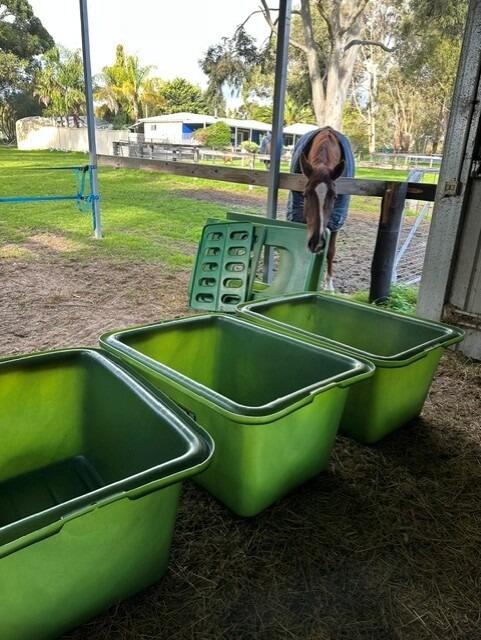
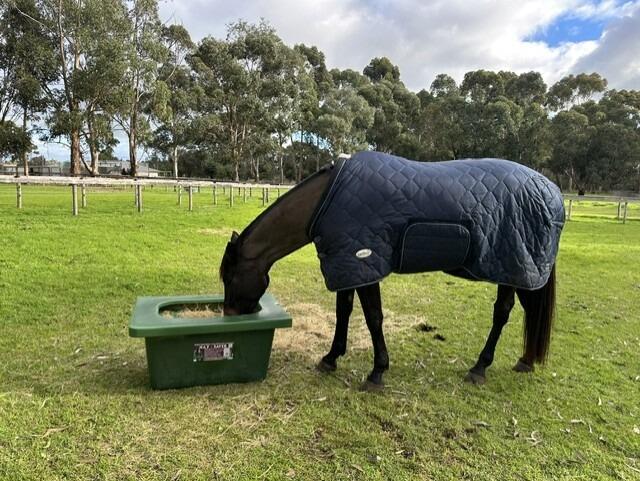
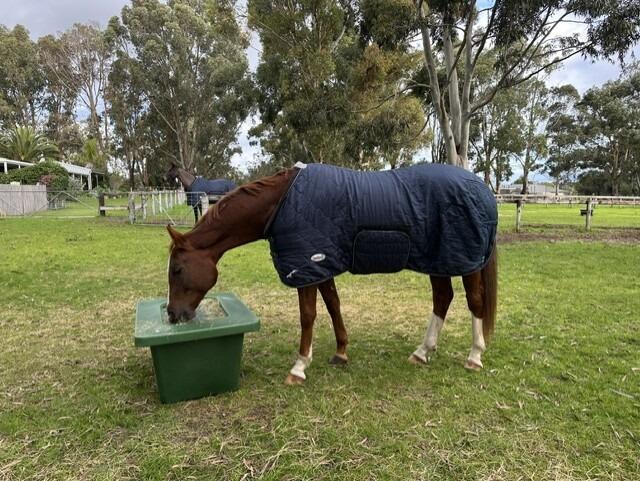
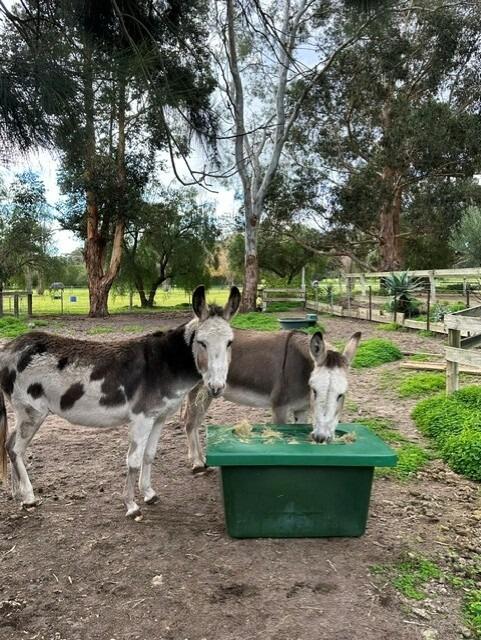
This is not ideal really. Its not easy to load and its quite awkward to use. Disappointed with it.
Its amazing
I have used the nets for awhile now but found it time consuming. So i bit the bullet and purchased the hay saver, it is fantastic. It is worth the price and results in less hay wastage. I am now considering buying a second!!
FAQs
Which Hole Size should I choose?
When choosing a hay net hole size, several factors should be considered. Here is a short summary of the key points for each hole size:

20mm Extreme Slow Feed Sized Holes:
- Suitable for "expert level" ponies that can eat from 30mm hay nets at impressive speeds.
- Recommended for horses or ponies that have mastered eating from a 30mm hay net.
- Ideal for feeding Lucerne to greedy horses or ponies.
30mm Decelerator Sized Holes:
- Great for voracious eaters, such as ponies, minis, and horses familiar with slow feed hay nets.
- Recommended for horses that have already used a 40mm hay net size hay.
- Laminitic horses usually benefit from 30mm sized hay nets.
- Relieves boredom for stabled horses or as a backup net for when the first hay net empties.
- Recommended for gutzy horses, ponies, or livestock, especially with palatable hay or slow feed experience.
- Not commonly used for goats, cows, or sheep, but some may use it with palatable hay.
40mm Moderate Sized Holes:
- The most popular hole size for slow feeding, accepted by over 90% of horses.
- Suitable for slightly stalky hay, providing hay-saving benefits and increasing hay longevity.
60mm Free & Easy Sized Holes:
- Ideal for saving on hay without significant restriction.
- Commonly used with low-sugar or coarse and stalky hay, great for older horses and cattle.
- Suitable for pregnant broodmares or younger horses where slow feeding is unnecessary.
- Caution: Ensure hoof size is larger than netting size for horse safety.
General Considerations:
- GutzBusta 40mm holes are a good starting point, with flexibility to go up or down in size.
- Weather and hay type can influence the suitable hole size.
- Palatability determines the hole size, with more palatable hay allowing for smaller holes.
- Horse's health status, weight, and workload should be considered when choosing a hole size.
- 40mm and 60mm sizes are suitable for saving on wastage, while 30mm slows down eating.
- Monitor horse's response when introducing a new hay net to avoid over-facing.
- Different livestock can use various hole sizes, with 40mm being common.
- Different hole sizes are used throughout the year, for various hays, health conditions, and weight management.
- Be cautious with shod horses and use appropriate hay rings/feeder to prevent entanglement.
- If you intend to soak hay in your net, we recommend rinsing the net in cold water prior to first use for a few minutes.
Which Hay Bag Size should I choose?
| Hay Net Size |
Knotless (Width x Height) |
Knotted | Approx Capacity |
| Extra Small |
55cm x 65cm 21" x 25" |
65cm x 55cm 25" x 21" |
|
| Small |
70cm x 80xm 27" x 31" |
85cm x 72.5cm 33" x 28" |
|
| Medium |
95cm x 85cm 38" x 34" |
105cm x 85cm 41" x 33" |
|
| Large |
140cm x 100cm 55" x 39" |
150cm x 110cm 59" x 43" |
|
| Extra Large |
160cm x 150cm 63" x 59" |
160cm x 150cn 63" x 59" |
|
|
Junior Hay-Stay Hanging Hay Net |
100cm x 80cm (With a 40cm hay flap) 39" x 31" (With a 15" hay flap) |
|
|
|
Hay-Stay Hanging Hay Net |
160cm x 100cm 62" x 39" |
|
|
Note: Weight can vary depending on the type of hay, whether you’re filling from a round bale or using biscuits/flakes, and how tightly the net is packed. Larger nets may also hold different weights based on the hay used. Our hay nets can handle a significant load, so the listed capacities are a general guide, they’re capable of holding more if required.
Knotless vs Knotted
Our Knotted and knotless hay nets are made from UV-stabilized polyethylene netting and have been in use for over 8 years. They come in various ply sizes and are tough, durable, and easily repairable. They have been used by many horses and can last 2 - 6 years. Knotted nets are suitable for soaking hay and do not take on the weight of water. They are available in black and offer hole sizes of 30mm, 40mm, and 60mm.
On the other hand, the knotless hay nets are made from high-strength, UV Stabilised polypropylene and have been available since 2019. They are softer and do take on some weight when soaked. The deluxe knotless nets are considered more luxurious and have become popular due to their softness. They are the strongest on the market with 240 ply and come in hole sizes of 20mm, 30mm, 40mm, and 60mm. Knotless nets are also only available in black.
When it comes to strength and longevity, there isn't a significant difference between knotted and knotless nets. Both types have proven to be tough, durable, and long-lasting. While some horses may prefer one material over the other, there is no way to predict which will suit an individual horse better without trying them. Ultimately, the lifespan of the nets depends on the individual horse and usage. Knotted nets have been used for 2 to 6 years without needing repairs, while the lifespan of knotless nets is still unknown after 3 years of use.
Safety & Cautions
-
Horns & Ear Tags: We do not recommend using hay nets with livestock that have horns, as netting can become caught or hooked. Similarly, if your cattle or calves have ear tags, there is a risk of them rubbing against the netting and catching a tag. This can potentially result in the tag being pulled out or the ear being injured. Although we have only ever heard of this happening with cattle, there is the probability that this could happen with other livestock such as sheep or goats so we recommend that you monitor your stock and be aware that this is a possibility.
For this reason, hay nets are generally better suited to hobby farm situations where stock numbers are low, and the benefits, (reduced waste, slower feeding, etc.) may outweigh the potential inconvenience of tag loss. Ultimately, it is up to the owner to assess whether this product is suitable for their livestock and setup. If you’re unsure, feel free to reach out and we can help guide you toward the best option.
-
Drawstrings: If you are putting your hay net on the ground (only if your equine isn’t shod) then there are two ways to deal with the drawstring. You can either tie a daisy chain knot, OR you can fill your hay net, tie off the drawstring at the netting end, and simply untie the knot that is at the end of the drawstring so there will be two lengths of drawstring hanging loose leaving nothing to get entangled in. For further instructions on these and other options, please read this link.
-
Sheep: If your sheep are eating hay where they will likely burrow their heads into the bale to chase seeds or more palatable sections of hay within the bale, then we recommend starting at 4cm (1 ¾”) sized holes, or 3cm (1 ¼) if the hay is REALLY palatable.
-
Shoes: If your horse is shod, simply tie your net up a little higher if it's a smaller net. If you're using a round bale or larger size net, put your net inside a hay ring or other structure that stops their feet from coming into contact with the hay net. Direct contact between shoes and nets is not recommended.
-
Buckled Headgear: It is not recommended to leave buckled halters or other types of buckled headgear on your horse when using ANY type of hay net as your horse may get caught.
-
Rugs: It's important to keep in mind that horses wearing rugs might rub against the nets. To reduce the chance of a rug clip getting caught on the netting, make sure your buckles are properly secured and not sticking out, or consider securing the hay net to limit contact between the rug and the net. If rubbing is a concern, you might want to avoid having your horse wear a rug altogether.
-
Small Hooved Animals: Monitoring small hooved animals that may jump on hay nets is recommended. Although we have never had an issue reported, it is advised to watch that small feet/hooves don't become entangled in the netting.
-
Removing Baling Twine & Bale Netting: Some of our photos show baling twine still intact or round bales with the original bale netting still surrounding the hay, with a hay net placed over the top. These images are for illustration purposes only and are not intended to demonstrate the recommended setup for feeding. We strongly recommend removing all baling twine and original bale netting once your hay net is filled, or during the filling process when dealing with round bales. The exception is Large Export Square Bales (8×4×4 / 8×3×4). With these larger bales, we recommend leaving either the bottom or second-bottom string in place until at least half of the bale has been consumed. This helps maintain the structural integrity of the bale while it is being fed.
- Important: Hay nets must never come into direct contact with hooves of horses wearing shoes, as this creates a serious entanglement risk. In our images, if a horse is shown eating from ground-level hay nets, they are barefoot, regularly trimmed, and not prone to excessive pawing. If your horse is shod or paws excessively at feed, this ground feeding method is not suitable and should be avoided.
Returns & Exchanges
We want you to be completely satisfied with your purchase from our store. If you have any issues with your order, please contact us at Gutzbusta so that we can make it right. We have a clear and concise Returns and Refund Policy to make the process as smooth as possible.
Returning Items
To return an item, please contact us at our customer service team via the email below. Make sure to include your order number when contacting staff.
Please pack the item securely in its original packaging and include all accessories and documentation, making sure the order number is clearly visible on the box. We will not accept items that have been modified or used in any way. You are responsible for the cost of return shipping, unless the item is damaged or faulty.
Email: admin@gutzbusta.com.au
Postal Address:
GutzBusta Hay Nets
Unit 7 / 1-13 Childs Road
Chipping Norton NSW 2170
Change of Mind
We accept returns for change of mind within 30 days of purchase. These can included swapping or exchanging item(s) for different sizes. The item(s) must be unused, in their original packaging, and in the same condition as when you received them.
We will issue a refund for the purchase price of the item(s) once we receive the item(s), excluding any shipping costs. While this process is under way, it is better to re-order with the correct item(s) to ensure your exchanged item(s) are delivered to you in a timely manner.
Incorrect Items Received
If you received the incorrect item(s), please contact us immediately. We will cover the cost of shipping the incorrect item(s) back to us. We will issue a replacement as soon as possible to you at no extra cost.
Damaged or Faulty Returns
If you receive damaged or faulty item(s), please contact us immediately. We will require photographic evidence of the damage or fault before we can process a return. We will cover the cost of shipping the item(s) back to us, and we will issue a replacement or full refund as soon as possible.
Damaged in Use
If your horse is using our nets and the net becomes damaged during use, please contact us immediately. We will require photographic evidence of the damage as well as the order number. Depending on the situation, we may offer a repair kit or exchange, subject to our discretion. Please note that general wear and tear, or damage caused by misuse may not be covered under our returns and refund policy.
Refunds
Once we receive your returned item(s), we will inspect it to ensure that they are in resalable condition. If the item(s) are in resalable condition, we will issue a refund to the original payment method within 7 business days. Please note that it may take up to 10 business days for the refund to appear on your account, depending on your bank or credit card company.
Thank you for shopping with us. If you have any questions or concerns about our Returns and Refund Policy, please do not hesitate to contact us.
Hay Net Hole Size Selection & Returns
Choosing the most suitable hay net hole size is an individual decision, as every horse, hay type and feeding situation is different. The way an individual horse responds to a particular hay net cannot be predicted with certainty before use.
We provide extensive pre-purchase information through our FAQ and product information pages to assist customers in selecting a suitable hay net, including guidance on hole sizes, hay types, feeding behaviour and other factors that can influence how quickly a horse consumes hay.
We are also happy to assist customers with choosing a suitable net before purchase. If you are unsure which hole size or net is most appropriate for your horse or management situation, we encourage you to contact us before ordering so that we can provide guidance based on the information you provide.
However, because the actual eating rate and response of an individual animal cannot be guaranteed, our hole-size recommendations are provided as guidance only. We cannot guarantee that a particular hole size, net size or style will produce a particular feeding rate or outcome for every horse.
For this reason, a hay net that has been purchased in good faith but is subsequently found to be unsuitable for a particular horse or feeding situation is not considered faulty or defective simply because the horse eats through it more quickly or slowly than anticipated.
Used Hay Nets
For health, hygiene and animal-welfare reasons, we cannot accept returns of hay nets that have been used, including where the customer has determined after use that the hole size, net size or style is not suitable for their horse.
Hay nets are feeding products that come into direct contact with hay and may also come into contact with saliva, food material, dirt and other contaminants during use. For this reason, used nets cannot be returned for resale.
We therefore strongly recommend using the information provided on our website and contacting us for assistance before using the product if you are uncertain about your selection.
We understand that finding the right combination can sometimes require some experimentation. A hay net that does not suit one horse or one type of hay may be highly suitable in another situation, so we encourage customers to consider the net as part of their overall feeding management rather than selecting a hole size based solely on the horse's size or breed.
Nothing in this policy is intended to exclude, restrict or modify any rights or remedies that cannot lawfully be excluded under applicable consumer protection legislation.
